
Jamui.
Until this week I could not have placed it on a map. Now I cannot find my way out of it.
The screen brought the day in like weather, a dense cloud of despair. The clip held a teenage girl to my eyes: face blurred, hands folded. Folded, because she was pleading to be left alone. Her harasser had covered his face — or some residue of unconscious shame — with a saffron scarf, that colour which in today’s India can sanctify the vilest part of a person. Then he picked her up. Like a thing. A rag doll, lifeless. I watched my inner landscape turn — clouds of despair breaking into a thunderstorm of rage.
In another city, a woman was raped, then another, then another. I have lost count. Or perhaps something in me is refusing to reduce raped women to a count.
Women have poured into the streets — to march, to protest, to revolt. Elsewhere, at the same time, people are marching because their names have vanished from the voters’ list. On a split screen they look like two countries. But are they? To my mind, it is one country discovering, in two registers at once, what it costs to be uncounted.
I watch from England, from a safe distance. Here I can watch my daughter grow into her body without constantly scanning who is watching her and turning her into an object. This is my exile: relief and guilt swaddled together. Here the news arrives already translated — grief with subtitles.
On the streets the slogans rise in crescendo: smash the patriarchy. But what makes a misogynist mind — and a misogynist State? When a growing boy is called sissy — ladki jaisa, like a girl; or namard, un-man — the label lands as an instruction: kill the mother inside you, and commit the matricide where all can see.
Reflecting on the cost of this murder, psychoanalyst Jessica Benjamin (1991) writes of a masculinity built by repudiating the mother, severing from her, rather than slowly, sadly differentiating from her, which never learns to meet a woman as a subject. A separation achieved by severing is never complete. He must keep repudiating his dependency and his identifica¬tion with her in order to claim the phallus. A woman can only be what he must not be. The space between two people, where mutual recognition could live, collapses into doer and done-to. Benjamin’s amendment of Freud — “where objects were, subjects must be” — is precisely the possibility a misogynist mind cannot afford. For that mind, wherever a subject appears, an object must be made of her. So the boy grows into a man for whom the murder is never finished. He must go on killing. Every woman who refuses to be an object — on a bus, on a street, at a microphone — is the mother rising again.
The murder that never ends sustains the misogynist mind.
But what is repudiated does not really leave. It is evacuated, then defended against — which is to say, preserved. Julia Kristeva called this evacuated-preserved part the ‘abject’: a horror that a man must ceaselessly throw out of himself. Following Benjamin and Kristeva, the first abject of the misogynist mind is the maternal body itself. Such a mind is not empty of femininity but occupied by it, held at the border, under guard.
My mind drifts to Ismat Chughtai’s “Lihaaf,” published in 1942 in the Lahore journal Adab-i-Latif. A girl is sent to her aunt’s house to learn how to be a woman. She learns instead to listen. Begum Jaan has been married to a Nawab who keeps boys and keeps his wife: she cannot go out, and he will not come in. She lies rigid under new cotton. Then Rabbu the masseuse arrives with her oils, and Begum Jaan’s half-dead body begins to fill out and glow. At night the child wakes to sounds, and to a shape on the wall, a shadow of the quilt, which Chughtai tells us seems to sway like an elephant. The child looks, once. As reader we are never told what she saw.
The elephant under the quilt or in the room is Chughtai’s. The state understood too, and could do nothing with its understanding. Summoned to the Lahore High Court in 1944 on a charge of obscenity, she was advised to apologise and refused. If she had committed a crime, she said, an apology should not spare her. She won, because the prosecution’s witnesses, asked to point to a single obscene word, could not find one. There was no obscenity in the story to convict. The court sat, like the child, watching a shadow it could not interpret and could not look away from.
But for the purpose of this essay, it is also important to note whom the state prosecuted. The Nawab’s appetite for boys is stated plainly and scandalises no one. Begum Jaan’s desire, never stated at all, brought a woman before a judge. It is as if, shame were distributed according to who is permitted to desire. Femininity in the nation’s male psyche is the elephant under the quilt. Everyone watches the shadow heave but the punishment is reserved for whoever might call it out.
I want to resist making this story lovelier than it is. The confinement that drove Begum Jaan to Rabbu also drove her, in Rabbu’s absence, to the child. It tells us that the abject does not only travel out of a man and into a woman; it travels downward, always, toward whoever has least standing in the room. The girl in the quilt’s shadow and the girl in Jamui are not the same girl. But both were sent to learn what a woman is, and both learned it from someone who had been taught by being made to carry.
Shame is recruited to keep the abject in exile, evacuated yet preserved.
Could rape then be a forced re-abjection?
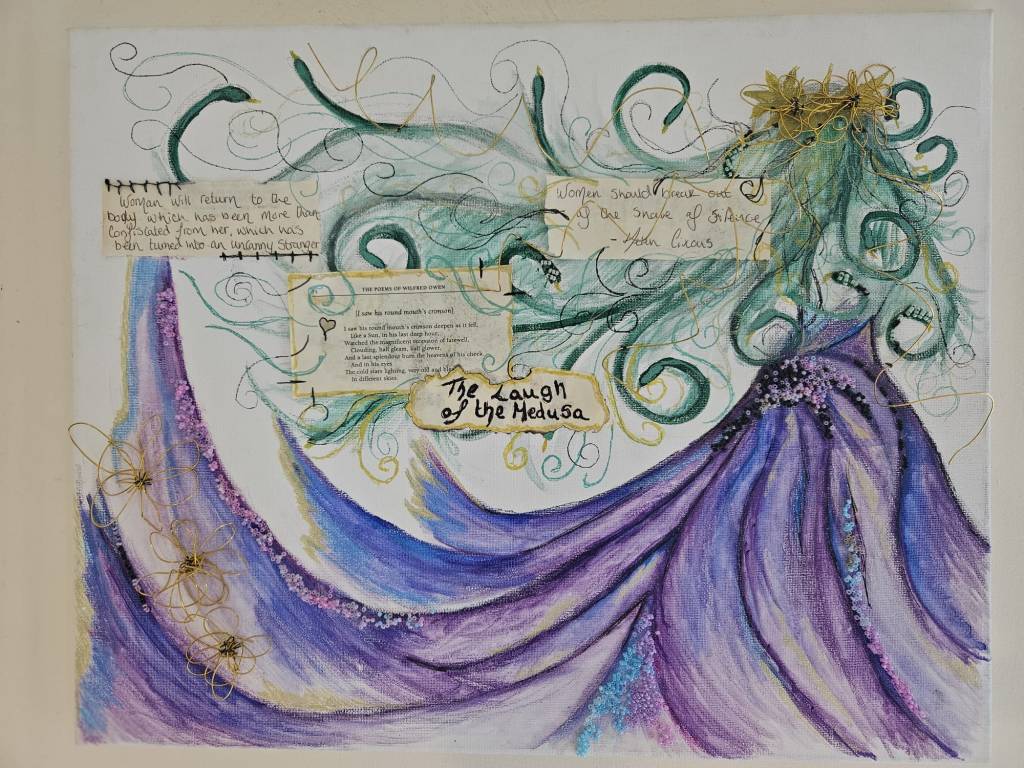
The evacuated thing cannot be held, so he makes her body hold it. Her body becomes the page on which his filth is written as hers. And, at least what is happening right now in India, it seems the state sanctifies the transaction: call it the saffronisation of re-abjection. She is put back in her place, inside the confines of maryaada. Though sometimes she finds the sacralised breach — you will see her swaying, dancing wildly, possessed by something no (hu)man can control.
What happens, then, to shame in the misogynist mind?
When writing about shame, Eigen recalls a childhood incident. He must have been seven, perhaps eight. His father shouting, raised hand and the boy Michael who had always wept discovered that something in him had clicked shut. He refused to cry, and vowed his father would never again have his tears. In the chapter, Eigen follows this refusal and the cost it entails, a sealing that solved nothing, a squeeze that can tighten around the self for a lifetime. Too heavy a cost for a perceived revenge against the father. The tears refused, and shame refused with them, and in the place where they had been, a steeling, with revenge already germinating in it like a seed in a fist. The vulnerable steeled boy is every man who was praised for the moment he stopped crying. Some grow into the men on the bus. And some, like Eigen himself, grow into an analyst who has spent sixty years sitting beside other people’s tears, un-clicking what clicked. There is hope. The misogynist mind is not a fate. It is a refusal that can, with enormous labour, be refused.
In a psyche that has abjected its own femininity, shame changes texture. It is stripped of its feminine tint — shame shorn of the grace of loving restraint. Michael Eigen reminds us that shame carries a double capacity: it can destroy, but it also keeps the world civil, restoring grace to living among other human beings. Strip that second capacity away and what remains cannot be borne inward as sorrow but it can only convert outward, as fury that migrates, is deposited in the body of the woman, who is made to carry his shame and the nation’s.
I am reminded of Amrita Narayanan’s work here. Listening to Indian women across three generations, Narayanan found that the control of female sexuality has served for centuries as “psychological scaffolding for the community psyche”. The community steadies itself on her restraint. Which means the shame the misogynist mind cannot hold is not simply dropped on a woman in the moment of violence but it was assigned to her long before, structurally, as load-bearing work. Her stillness holds the building up. So when a raped woman is shamed while her rapist is garlanded, the nation is not making an exception to its architecture but sustaining it. The scaffolding must not be seen to shake, and so the killing of the feminine goes on. Shame changes address. In the protests, the uprising, the murdered feminine returns. She possesses the crowd, sings slogans as she plays the tambourine and gracefully and gorefully threatens to overthrow the ones who abjected her. Sharam karo, the streets chant. Have some shame. She is pushing shame back to its proper address.
In Civilization and Its Discontents, Freud described the bargain: we surrender a portion of our aggression, and civilization holds the surrendered portion in trust. The superego, wearing the state’s face, polices the ledger. The contract exists because the wild parts do. But looking at the state of things, not just in India but the world over, I wonder what happens when the guarantor of the contract goes wild. When the state refuses renunciation. When it does lawless things with lawful instruments. The surrendered aggression returns, twice unbound: in the men, and in the institution.
Into this national emotional matrix arrives the fact of State-governed deletion — of voters, of dissent.
Investigative reporting, including Ritika Chopra’s work in The Indian Express, has documented deletions on a vast scale in the country. I think of Arundhati Roy’s words that there is no such thing as the voiceless, only “the deliberately silenced, or the preferably unheard.” A voters’ roll is a republic writing down whom it can hear. Deletion is preference. Deletion is sifting. To be un-named is to be un-happened.
The temporality is striking. The deletion of women from their own bodies; the deletion of the body politic, voter by voter, of those who might disagree. The simultaneity of the marches says it plainly: what rape says to a body, deletion says to difference. The feminine, the distinctly Other, must be eradicated at all cost. Erase the Other. Erase the source of dependence, source of original dependence, and of all the subsequent ones that might remind of the original one and the painful severance from it that living necessitated.
Invoking Sudhir Kakar, Narayanan writes, “Writing in 1978, Kakar observes: ‘For the Indian woman, sex is a so¬cially sanctioned erotic renunciation.’ The declarative nature of this sen¬tence seems to speak more for a faceless ‘India’ and less for individual women who fight against the renunciatory force in women’s Eros. I would re- write the sentence as: ‘Every Indian woman has to fight against the so¬cially sanctioned voice that persuades her to renounce Eros.’ The pressure to renounce Eros— which their socio- economic male counterparts do not face— is a source of enormous rage for women, a feminist cause that still goes largely unspoken for.” A woman revising the inherited sentence of a man, refusing his verdict, that is what the streets are doing to the nation’s sentence. It is also what I am about to do to a poem.
Amrita Pritam’s poem, summoning Waris Shah from his grave, comes to mind unbidden, as poetry does especially when mind is tormented. Pritam, amid Partition’s abducted and raped women, summoned a dead poet to rise from his grave and witness. Reader, consider this essay a refusal of that summons. I will not call dead men to witness. But I will call a woman.
Ismat Chughtai…
Today I call you
speak from wherever the censors filed you.
not from a grave for I am done with graves,
done folding hands and pleading with the dead to see.
They dragged you to court for a shadow,
You did not apologise for the quilt
teach us your unrepentant spirit,
the words that would not lower their gaze.
They are deleting the names now, Ismat.
A girl in Jamui, deleted by lifting;
Another deleted in Delhi.
And deletion goes on
Raped every 16-17 minutes, they say
The State’s ink dries both ways.
So no!
I refuse to summon Waris Shah.
Let the men’s graves keep their peace.
I call the woman who called out the shadow.
I call every hand that rises as fist in the sky
This sky that watches but never strikes lightning
I call every hand that strikes the tambourine in protestful cadence
I call every hand to write its own name back.
References:
- Benjamin, J. (1990). An outline of intersubjectivity: The development of recognition. Psychoanalytic Psychology, 7(Suppl.), 33–46.
- Benjamin, J. (1991). Father and daughter: Identification with difference — A contribution to gender heterodoxy. Psychoanalytic Dialogues, 1(3), 277–300.
- Chopra, R., & Nath, D. (2026, September 23). 14 times in 10 months, two Election Commissioners objected on record to poll panel steps. The Indian Express. https://indianexpress.com/article/express-exclusive/election-commission-sir-14-objections-gyanesh-kumar-sukhbir-singh-sandhu-vivek-joshi-10889737/
- Chughtai, I. (1990). The quilt. In The quilt and other stories (T. Naqvi & S. S. Hameed, Trans.). Kali for Women. (Original work “Lihaaf” published 1942 in Adab-i-Latif)
- Chughtai, I. (2012). A life in words: Memoirs (M. Asaduddin, Trans.). Penguin. (Original work Kaghazi Hai Pairahan published 1994)
- Eigen, M. (2016). Shame. In Image, sense, infinities, and everyday life (pp. 61–86). Karnac.
- Freud, S. (1961). Civilization and its discontents. In J. Strachey (Ed. & Trans.), The standard edition of the complete psychological works of Sigmund Freud (Vol. 21, pp. 57–145). Hogarth Press. (Original work published 1930)
- Kakar, S. (1978). The inner world: A psycho-analytic study of childhood and society in India. Oxford University Press.
- Kristeva, J. (1982). Powers of horror: An essay on abjection (L. S. Roudiez, Trans.). Columbia University Press. (Original work published 1980)
- Narayanan, A. (2023). Women’s sexuality and modern India: In a rapture of distress. Oxford University Press.
- Pritam, A. (1947). Ajj aakhaan Waris Shah nu [Today I call to Waris Shah] [Poem].
- Roy, A. (2004, November 3). Peace and the new corporate liberation theology [City of Sydney Peace Prize Lecture]. University of Sydney.
- Tewary, A. (2026, September 22). Minor girl, her friend harassed in Bihar’s Jamui. The Hindu. https://www.thehindu.com/news/national/bihar/minor-girl-her-friend-harassed-in-bihars-jamui-culprits-in-police-custody-political-slugfest-ensues/article71490725.ece


