

Notes from a cusp in the Indian collective psyche
By Shalini Masih and Ashok Nagpal
Birthing the Abject…
On 15 May 2026, during a Supreme Court hearing on fake degrees, India’s Chief Justice was widely reported to have said: “There are youngsters like cockroaches, who don’t get any employment.” He later clarified that he had meant only those with forged credentials. But baat niklegi to phir door talak jayegi. A word, once spoken from the highest bench in the land, does not belong to its speaker any more. Within days, millions of young Indians had done something unanticipated: they took the insult and wore it like a crown!
A parody outfit calling itself the Cockroach Janta Party. A pun folded into the ruling party’s own name. They appeared online with the bug as their symbol, and within a week their Instagram following had overtaken that of the ruling party itself. Its membership criteria: unemployed, lazy, chronically online, able to rant professionally. Its manifesto: satirical on the surface, and underneath the satire a set of startlingly sober institutional demands, such as examination integrity, judicial independence, curbs on the revolving door between bench and government.
What followed after their birth is, to our minds, poignant for multiple reasons. The young people dressed as cockroaches went down to the Yamuna, that most sacred and most defiled of rivers, and started to clean. But this cleaning or decluttering began to extend beyond as the young began to take to the streets, through peaceful protests, making the filth of the society so known that it has now become impossible to unsee it.
The state could have responded with a dialogue but instead the movement’s social media accounts were blocked. The Intelligence Bureau reportedly flagged a meme page as a threat to national security. And then, in early July, the state retreated: before the Delhi High Court, the government offered no objection to unblocking, explaining that the ban had only ever been about the timing of the NEET examination — posts that might have caused “chaos” among anxious students and parents, nothing more. The court ordered the account restored. To a psychoanalytic mind here was a paranoid gesture, unable to be owned, retroactively renamed as administrative housekeeping. In psychoanalysis we understand this as disavowal, and yet there is something here that calls for deep reflection and deeper engagement with the collective psyche of the young, and with the psychic structure of the official order they are standing against, because I sense that we are watching something at a cusp, and because the shape of this cusp is one that psychoanalysis, read alongside India’s own devotional inheritance, is unusually equipped to see.
Wearing the projection…
When we zoom in at the founding gesture behind this movement — a paternal state, through the mouth of its highest court, the very tribunal of the symbolic father, expelled its unwanted contents into its young: “you are vermin, parasites, cockroaches, parjeevee, the unassimilable remainder of our growth story!” Usually such expulsion into the other offers two roles only. Either this other collapses under the projection and becomes the degraded thing. Or this other hurls it back with violence, thereby confirming the projector’s persecutory world-picture and licensing the crackdown that was, in a sense, already waiting.
What is remarkable here is that the Gen Z did neither!

They demonstrated a third route. They wore the insult as a crown. They received the projection playfully and returned it transformed — as joke, as costume, as identity badge, a cockroach emoji in the social media bios, as a mark of belonging. Psychoanalyst, Wilfred Bion’s would call it an alpha-function performed by a generation where the raw, unmetabolisable stuff of humiliation — beta-elements, the system’s indigestible debris — taken in, dreamt over, and converted into something thinkable, shareable, and above all funny! The group became its own container. What could not be digested was not evacuated back as violence; it was composted into meaning and playfully so.
Another psychoanalyst, Donald Winnicott wrote, “in playing and only in playing” that the individual is able to be creative, and only in being creative that the individual discovers the self (Winnicott, 1971, p. 54). The movement’s refusal of both compliance and retaliation opens a third area — transitional space — and this in-between area of Play is precisely the space tyranny cannot enter, because tyranny is, among other things, the foreclosure of Play.
An authoritarian order can metabolise an enemy; it cannot metabolise Play.
The Gandhian structure…
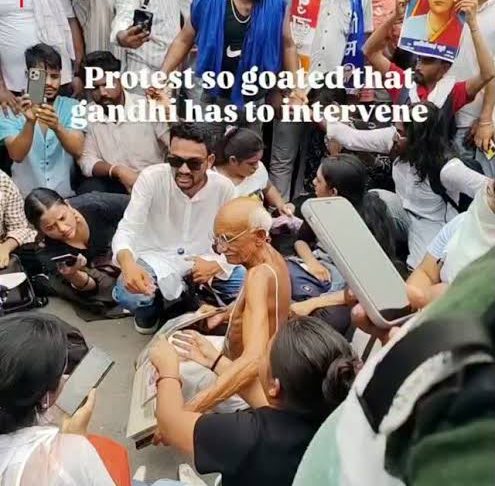
There is an unmistakable Gandhian quality in the movement’s non-violence, its constructive gestures and its cheerful discipline. But this resemblance runs deeper than mere tactics. What made Gandhi psychologically illegible to the Empire — was his instinct to identify downward. He took the abject upon his own body: the latrine-cleaning he insisted upon at the ashram, clad in a muslin dhoti, the deliberate identification with those his society had made untouchable, the fasting body made small and low on purpose. Satyagraha does not contest the elevated position; it sacralises the despised one, and thereby quietly dissolves the whole vertical axis on which domination not only depends but thrives on.
The cockroach children are repeating this gesture without citing it. The state says: “You are cockroaches!” Their response is not — “No, we are dignified citizens!” Instead, they respond with — “Yes! And watch what the cockroach can do!” Then they descend to the filthy, holy river and clean it: Gandhi’s constructive programme performed as a meme. Erik Erikson, in Gandhi’s Truth, called Gandhi a “religious actualist” — one for whom the truth is not held but enacted, made actual in the body and the deed (Erikson, 1969). Sudhir Kakar, who wrote with such tenderness and unsentimental precision about Gandhi’s body, his relation to women, his experiments in self-fashioning — and who, in Mira and the Mahatma, entered the correspondence between Gandhi and Madeleine Slade to show devotion itself as a field in which two people remake each other — would, we think, have recognised immediately what this generation is doing with its bug avatar — presenting irony as a devotional practice, a sadhana.
The man India calls the Father of the Nation was the one who identified with the abject. The father-imago currently on offer identifies with the grandiose: the fifty-six-inch chest, the temple consecrations, the face on every hoarding. The children, in choosing the cockroach, are choosing their descent — deciding, in effect, which father they are descended from. Sigmund Freud’s Moses and Monotheism hums underneath: the murdered father — and Gandhi was murdered, by an ideological ancestor of the present dispensation — does not stay dead. He returns but not as an idol or a postage stamp, both of which the official order has comfortably absorbed, but as method, in the bodies of the great-grandchildren who never knew him and mostly do not invoke him. The return of the repressed father, wearing chitin.
Gandhi’s name for his method held its philosophy in a single compound: satyagraha, truth gripped with the body until either the holder or the lie gives way. But there is something more here along with Satyagraha. And this ‘something’ resides in the various expressions of this generation. The sant tradition has a name for speech that works by deliberate inversion: ulatbansi, Kabir’s upside-down language. One of its best-known verses runs:
“pahile poot pichhe bhai mai,
chela ke guru laage pai”
first the son was born, then his mother;
the guru falls at the feet of the disciple.
A mother is born as mother only in her child’s arrival, and the teacher who has truly taught ends at the student’s feet. Ulatbansi carried a paradox, language is turned on its head because the truth it carries cannot survive being said the right way up. It is this language that this movement speaks.
A generation calling itself cockroach in order to speak dignity…
A party campaigning as the lazy, the unemployed and the chronically online in order to speak seriousness…
An insult worn as a crown in order to speak the shame that was never theirs…
The young themselves might reach for absurdism. Stand outside the reel, the play and it is nonsense. Stand inside it and every inversion lands with the accuracy of a poet’s verse. The state’s confusion, its lurching between raids and retreats, is the confusion of a listener who has only ever heard language the right way up. Such a pity to remain outside of and bewildered by the magic of language that this generation seems fluent in! Kabir’s descendants are speaking ulatbansi to power, and power is stumbling to decide what to do without being rendered ridiculous. That undecidability is not a flaw in the message but the message itself.
Kafka, or creaturely life…

The movement’s own aesthetic points to Prague. Gregor Samsa wakes one morning transformed into an Ungeziefer — a word usually translated as “vermin,” whose older sense is the creature unfit for sacrifice. The horror of Kafka’s story, Metamorphosis, is not the transformation; it is that Gregor’s family cannot metabolise him. He dies, slowly, of their disgust. What is unfolding in India is the Metamorphosis run in reverse: because here the metamorphosis is willed, collective, and declared with a grin. An entire generation wakes up, announces that it has turned into a vermin — and thrives, through a vehement refusal to die of the disgust and disdain of the authority. This creature has decided to keep its own company, nineteen million strong and growing as we write.
Cultural theorist and literary scholar Eric Santner’s notion of creaturely life is useful here. According to him, the “creature” comes into being by sovereign power at its own edge — the life that carries the excess, the remainder, of the sovereign’s exception (Santner, 2006). The cockroach is the perfect creaturely emblem, and the young seem to know it. The being that survives the apocalypse the powerful make. And here lies another inversion. The strongman’s psychic architecture is vertical, singular, headed — one face, one voice, one chest, one office. The present movement is horizontal, anonymous, swarming — millions of small survivors and no head to decapitate. A paranoid ego organised around the persecutory enemy cannot find purchase on a laughing swarm. There is no one to arrest who is not instantly replaceable, no leader whose humiliation would decapitate the body, because the body was never organised around a head.
The tyrant’s predicament…
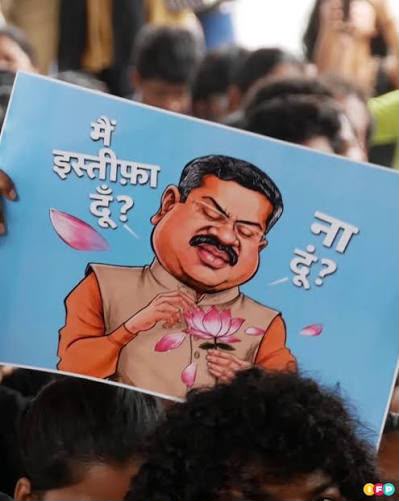
Satire is uniquely unbearable to a grandiose formation because it attacks in the register of shame, not guilt. And the grandiose self has no apparatus for shame, only for enmity. Psychoanalyst, Heinz Kohut described narcissistic rage as “the need for revenge, for righting a wrong, for undoing a hurt” (Kohut, 1972, p. 380), a need that admits no proportion and no rest. Another expert in psychoanalysis, Otto Kernberg’s wrote that there sits a paranoid core beneath the grandiosity in malignant narcissism: the conviction that the world is populated by enemies, which is also, secretly, a hope. For this reason, a violent opposition would be a relief. It would confirm the persecutory world-picture, justify the state’s musculature, and restore the fight-flight register in which such a formation knows how to live. You may see this unfolding in how the state needs the leader of opposition as an ‘enemy’, an intimate enemy.
But, Play and Laughter offers nothing to fight!
So what does the state do with it?
The only thing its structure permitted was to treat a meme page as a matter of national security. In doing so it enacted, in public, what Christopher Bollas calls the fascist state of mind — a mind that achieves certainty by murdering its own internal opposition, simplifying the psyche into a “moral void” where nothing ambiguous is allowed to live (Bollas, 1992). But the challenge Gen Z has posed is through play and humour which by their very nature are ambiguous; that is why it is always the first thing such a mind reaches to kill, and why its assassination attempt always fails so instructively.
In humour, wrote Sigmund Freud, “the ego refuses to be distressed by the provocations of reality”; the superego, for once, turns kindly and says to the frightened ego: look, this world of dangers is only a game (Freud, 1927, p. 162). The various expressions through reels, memes, posters, art that are emerges from cockroaches are exactly this: a generation’s superego refusing the state’s invitation to terror, and comforting its own ego with laughter, play, kindness, care and love for one another. Against a politics of fear (darr ki rajneeti), Play is not a deflection but a declaration that the ego will not be made to suffer, that here fear has no place.
And here we find echoes of Winnicott (1969) — The subject destroys the object in fantasy, and if the object survives — without collapsing, without retaliating — it becomes real, usable, lovable outside the shadow of omnipotence. Satire is destruction-in-fantasy. It is the group testing whether the State can survive being played with! But in responding to memes with the Intelligence Bureau the State has failed the test in full view, revealing that it was only ever available as an idealised object and idealisation is always waiting to tip. The courtroom retreat of early July, with its face-saving story about examination timing, is the tipping made visible. The state that lacks the courage to admit that it was frightened of a joke! So instead it says it was protecting students from chaos.
Tending the Mother’s Body — or Possessing It…
India does not only have fathers, she is, in its own self-imagination, a mother, Bharat Mata, the nation as goddess, an imago born in the colonial nineteenth century and never since at rest. And at the Cockroach Janta Party’s gatherings, among the memes and the insect costumes, in reel after reel protesters have been heard raising the oldest cry of Indian mass politics: Bharat Mata Ki Jai. Victory to Mother India.
We wonder if when the young took to the river or the streets in protest, perhaps something older than the meme was moving through them: the descent to tend the mother. And here the Gandhian resonance deepens and darkens at once. Gandhi was the father who scandalously made himself the tending child through acts such as latrine-cleaning, a softening of his own body and politics, he located the nation’s regeneration not in conquest but in care of the defiled. The strongman’s body politic is sealed, ascending, tended by no one. Gandhi’s was porous, stooping, and its devotion ran downward — toward the lowly, the fouled, the mother nation.
But whoever brings Gandhi to the mother’s body must bring all of him. His tending of the feminine was entangled, as Sudhir Kakar showed with such unflinching tenderness in his writing on Gandhi and women, with his need to master it — the brahmacharya experiments in which young women’s bodies were made instruments of an old man’s purification; the women asked to hold still so that his truth could be tested upon them (Kakar, 1989; 2004). The question his life left open is the question the movement now inherits: Can one tend the mother’s body without possessing it? Is there a devotion to the mother that does not end in her capture?
Kabir’s upside-down verse already carries an answer: pahile poot pichhe bhai mai — the son first, then the mother. Bharat Mata does not precede her children; she is born out of their tending, made a mother again each time a generation kneels at her, tends to her. A mother who exists only as prior — eternal, sealed, demanding — is not a mother but a possession. The protests, read through ulatbansi, are not the children serving a pre-existing goddess. They are giving birth to her.
And the instruction of Eigen, of Gandhi and of Kabir goes one rung further still to seek, through an inhering explosion, a formation that has no creator — thus no mother, no baby, no person! A devotion that can never turn to possession, because it has finally let go even of the beloved’s form. Our feeling-thinking should be led astray at this very point – deservedly, we sense – to lose further thought! We have known only few moments when Indian collective psyche has brushed against such a formation.
The first emerges from a film that has become extremely popular recently. For the psychoanalytic mind though, such popularity speaks of the profound resonance the collective has stumbled upon with the film, even though this resonance was always waiting to be found. The character from the film, Keenu, secreting a pull that only Nirvair, his grandson, can muster the focus to catch — against tides dragging him away from all directions, including his own repetitive stumbles in the sphere of work and professional identity, ever so slowly in the beginning. Death as a gesture of salvational release and simultaneous merger in love, presented vivaciously in the beloved’s image as it is enlivened for Keenu (and for viewers no less), suggests we cannot rest well with the explosive nature of Truth in the finale unless we extend its scatter-patter into an alluring melody — the song ‘Kya Kamaal Hai’.
The second moment emerges from Parliament, July 2018, during Rahul Gandhi’s address in. During the debate on the No-Confidence Motion in the Lok Sabha after delivering a fiery speech criticising the government’s policies and personal conduct, Gandhi—then the Congress president—walked across the floor of the House to the treasury benches and gave the Prime Minister a surprise hug. Returning to his seat, he was seen winking, an act that drew its own storm of commentary. He later explained that while he strongly disagreed with the Prime Minister and intended to fight him politically, he harboured no personal hatred toward him. The Prime Minister, in his own address, characterised the move as “arrogance” and a desire to occupy his chair. And yet it was perhaps the only occasion in our Parliament since 2014 where MPs of every hue and political affiliations experienced the humour of the whole interaction – and the Prime Minister himself could live a certain warmth, and extend it, if only for that moment. This may have been the precedent scene, since lost completely, because Indian society does not think psychoanalytically or draw upon its own scriptural knowledge of dream-states and so stamps itself as unequipped to harness those energies towards harmonising our positions during crisis out of self-accord, rather than in reaction to external dangers and crises precipitated therein.
But such moments are summits, glimpsed and lost. The pains below them are contested ground. The mother-imago, in Indian political life, has been captured before — and recently. Bharat Mata has been made a checkpoint: a chant administered as a loyalty test, a goddess redrawn as a border, the mother in whose name people are asked to die and neighbours from minority communities are asked to prove themselves. The maternal register is not innocent. A politics of the mother can open into tending — reparative, horizontal, the bhakti of the fouled river — or it can close into a new totalisation: the devouring mother who demands sacrifice, the purified mother who must be protected from contamination, which is always, in the end, protection from other people. The abject reclaimed can harden into identity, and identity, as Julia Kristeva showed, founds itself by expelling a new abject (Kristeva, 1982). Societies have never been without their abjects. Nothing guarantees that the cockroach, having survived its own expulsion, will not one day discover vermin of its own.
The movement was born in play. And movements born in play have been captured before — the anti-corruption effervescence of 2011 became a party, and the party became a politics like other politics. The children have found the mother’s body and knelt at it. We wondered if they would tend to her or without knowing it claim her. But this Gen Z-led movement has shown us that their descent is driven by love and not another opening move of a new mastery.
The Inversion of the Mystical Register…
But what is happening in India right now is not only political but also mystical? That is not a very good distinction anyways. Perhaps it is a contest between two mysticisms.
Ruth Stein, writing after 9/11 in For Love of the Father, anatomised the vertical mysticism of tyranny and terror: ascent, purification, submission to an exalted father who demands the abolition of the self, transcendence as annihilation (Stein, 2010). One does not need to look far to see the current dispensation trading in a domesticated version of this register — the sacralised strongman, darshana of the non-biological leader, the temple consecration as state spectacle, transcendence administered from above.

What the cockroach-children have found — without, we suspect, knowing it fully — is the other mysticism, the one India has kept alive for a thousand years in the mouths of weavers and cobblers and possessed village women: immanent, low, horizontal. The sacred is seated not above the world but in its most despised crevices. It is bhakti’s oldest move.
Kabir addresses the divine from the dust and laughs at the pundits and the mullahs alike; the low position, fully entered, becomes the beloved position. When a generation takes the name of the most reviled creature in the house and then goes down to welcome the ‘filth’ in the society, it is performing — in meme-time, in play — a gesture that India’s devotional traditions would recognise instantly. Humility becomes intimacy with the real.
We have spent years listening to states often considered as degraded — spirit possession in North Indian healing shrines — and learning to hear in them the disavowed psyche finding voice in the idiom available to it. We wonder if what is happening now is a possession state of the body politic. The nation’s split-off abject has begun to speak, and it speaks, as the possessed so often do, in the voice of the lowest available creature — and what it says is nourishing precisely because it shatters the official surface. Michael Eigen, reading Bion, puts the dialectic exactly: “truth may nourish and lies poison, but truth, also, is explosive” — like God, it can shatter the personality that beholds it (Eigen, 1998, p. 12). A collective that has begun to feed on a shattering truth cannot easily be returned to the poison.
What we are witnessing in the present moment is what psychoanalyst Wilfred Bion would call catastrophic change: the established container confronted by a new thought it cannot hold without being reshaped (Bion, 1970). The question a paranoid establishment cannot ask — because its structure forbids it — is whether the catastrophe might be generative. Whether the swarm at the gates is not the end of the house but the return of everything the house threw out in order to feel clean.
The Body At Jantar Mantar…
At Jantar Mantar Sonam Wangchuk ate nothing for twenty-one days. He lost more than eight kilograms; his muscles consumed themselves; many begged him to stop, and the government said nothing at all — until, two days before the march on Parliament, it answered. At dawn, plainclothes police removed him from the site and took him to hospital, citing court directions and medical advice. In the same hour, the movement’s young founder was detained and beaten. The state’s first reply to a fasting body was silence; its second was an ambulance with policemen inside it. Care as custody. The paranoid gesture, once again unable to be owned, renamed as concern.
Chela ke guru laage pai — the guru falls at the feet of the disciple. An elder of the Gandhian lineage placed his body in service of the young’s method rather than instructing them in his own; the teacher was at the students’ feet, and for many days it was mostly his body, and his alone, that carried the truth.
We will confess the doubt we held, because the answer that came deserve to be measured against it. We had wondered whether a movement so fluent in reels would ever become flesh – whether the ulatbansi speech would come down into bodies. Gandhi’s method always had a body inside it. What made him illegible to the Raj was never the wit alone. It was the flesh.
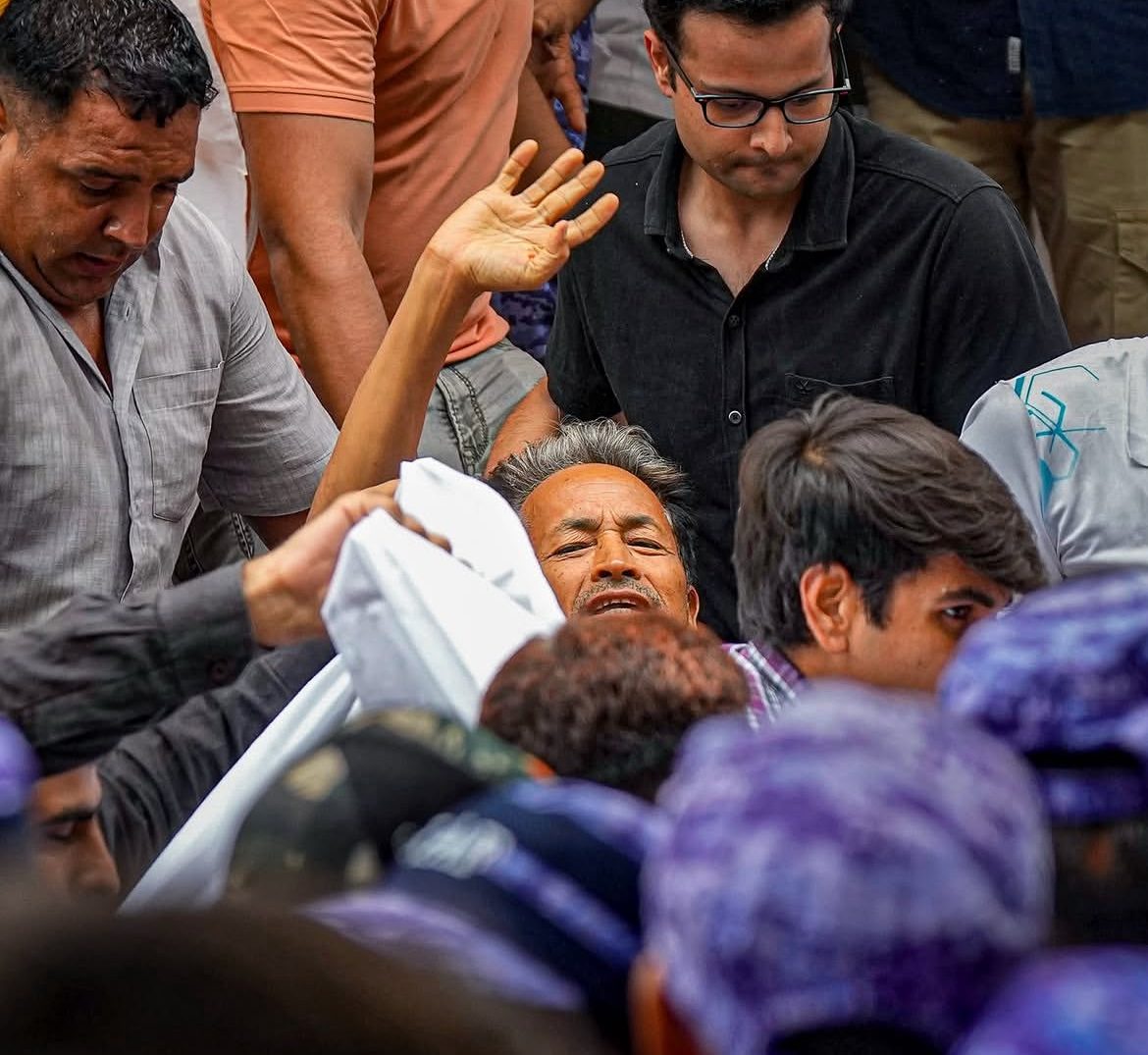
And we have spent years in the healing shrines, know that possession is never virtual. Trance is sweat, the god arriving in trembling limbs, in a body laid flat against the earth. We wondered whether the swarm would sweat.
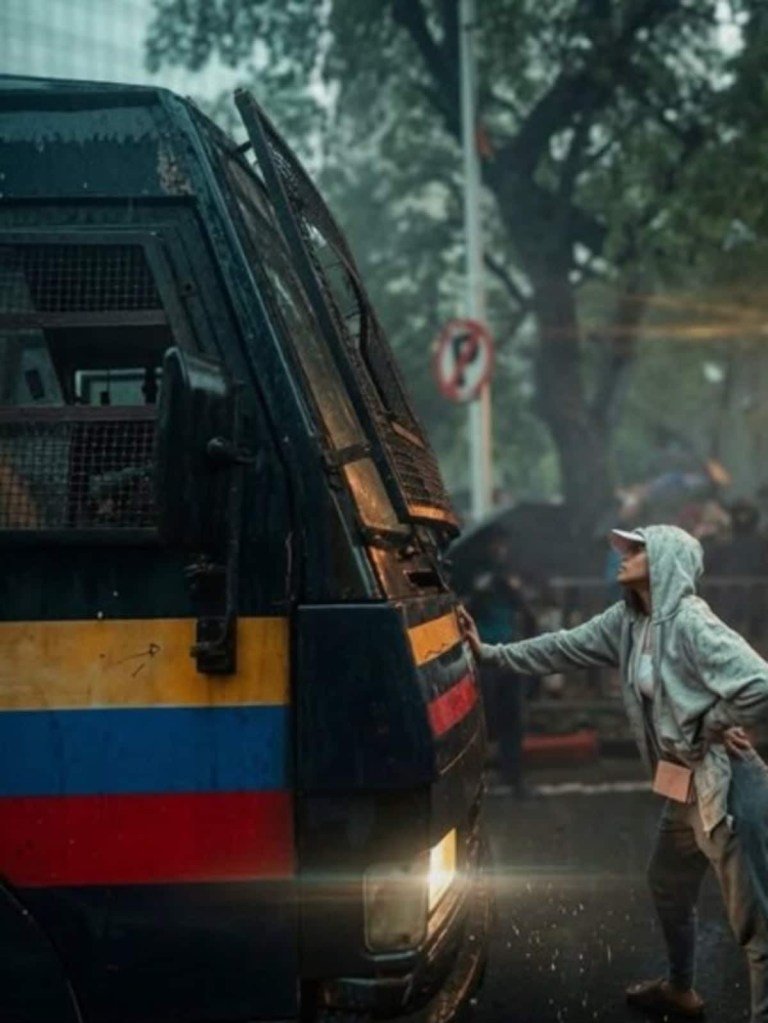
It is worth remembering where ulatbansi came from. Kabir sang his reversals at the loom — the upside-down verses issued from working hands, from a body bent over warp and weft in the dust of Kashi. The paradox was never disembodied with Kabir, but it had a weaver inside it. Perhaps that is why this generation’s inversions could come down into bodies when the morning demanded it. The tradition they have been unknowingly speaking had flesh in it from the beginning. The missed call that summoned them costs nothing – that was its genius and its danger in a single gesture. But on the twentieth of July, the costless call was answered at the highest possible price, in bodies that walked into the sticks and did not turn. They came through the night on trains and buses from across the country, in the rain, knowing the march had been declared illegal, knowing what waits for the unarmed who walk toward power in this season. And when the lathis came down along with the tear gas, they did not strike back. Gassed, they washed each other’s eyes. They formed chains of their own bodies around the ones still fasting.
This is where we, as psychotherapists, must simply bow. For what we watched that morning was not passivity, and it was not the absence of rage. It was rage metabolised – held in the body, felt to its full raw vitality and yet refused as retaliation, in the very instant it would have been most justified. To take a blow and not return it is, perhaps the most difficult labour a psyche can perform. It is containment enacted under conditions that would break most of us who theorise it from our chairs, our silos. Wilfred Bion described the mind that can hold beta-elements, raw unthinkable states, without evacuating them; these protestors did it bleeding from the head. We have spent our careers helping individuals, in the safety of a consulting room, to hold a fraction of what this generation held collectively on a wet morning under assault. We do not write this to bless them from above but to recognise that they have shown us something about our own discipline’s highest aim, the transformation of unbearable affect into meaning rather than revenge and that we are their students in it — chela ke guru laage pai…
Notice, too, what the state reached for. It detained the founder — of a movement whose whole form, is that it has no head. A paranoid structure cannot imagine a body that is not organised around a head, and so it decapitates, and decapitates, and each time the swarm closes over the empty space. The arrest is not only an injustice; it is a confession of illiteracy.
The audacity of repair…
Sigmund Freud, replying to Albert Einstein on the question of war, wrote that “whatever makes for cultural development is working also against war” (Freud, 1933) — and cultural development is, in great part, the stubborn labour of artists, storytellers and thinkers who keep the vital spark of meaning alive while empires burn. The young are performing reparation, the kind that emerges from guilt but that which is birthed out of a fierce love for life, for survival and for bringing the good back. This is revealed in how they are seen tending to each other, to bruised bodies, even to the very police personnells who caused those bruises. The protest sites are thick with this labour: care for each other, for those arriving, for the aggressor, for the space they are all inhabiting, protest songs, poetry, slogans, costumes — and among the verses, inevitably, Faiz, whom these protests have made their own. Hum dekhengay… Lazim hai ki hum bhi dekhengay… We shall see — the ghazal takes this essay’s own anxious waiting, which way will the wheel turn, and converts it into promise. Do what is yours to do. What will be, will be seen.
Tyranny is anti-aliveness: it wants stillness, uniformity, the single face repeated forever. What makes this movement feel like a cusp is that it is alive in a way the official order is not — it has passion, play, mischief, connection, the field between people that Kakar taught us to call Erotic in the widest sense not in a narrow sexual sense. A whole generation’s aliveness, refusing to dim on command.
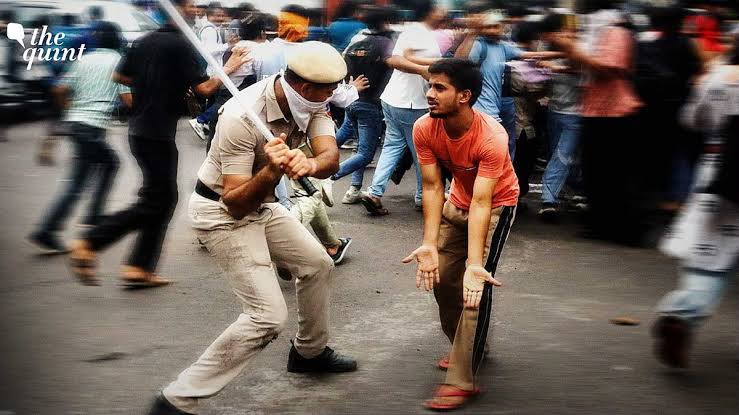
Baat niklegi to phir door talak jayegi. The word has completed its journey now: it left the highest bench as an insult, was caught mid-air and worn as a crown, took to the streets, passed through Kabir’s loom, Gandhi’s wheel, and on the twentieth of July it walked through lathis, tear gas and did not strike back. Somewhere along the way, it became a teaching.
The cockroach, of all creatures. Unkillable, ancient, insistent as Life itself — laughing at the tyrant outside and the tyrant within, and beneath the laughter, beginning to sing.
References
Bion, W. R. (1970). Attention and Interpretation. London: Tavistock.
Bollas, C. (1992). ‘The Fascist State of Mind’, in Being a Character: Psychoanalysis and Self Experience. New York: Hill and Wang.
Eigen, M. (1998). The Psychoanalytic Mystic. London: Free Association Books.
Erikson, E. H. (1969). Gandhi’s Truth: On the Origins of Militant Nonviolence. New York: Norton.
Freud, S. (1927). ‘Humour’, Standard Edition, Vol. XXI. London: Hogarth Press, pp. 159–166.
Freud, S. (1939). Moses and Monotheism, Standard Edition, Vol. XXIII. London: Hogarth Press.
Hess, L. and Singh, S. (trans.) (2002). The Bijak of Kabir. New York: Oxford University Press.
Kakar, S. (1989). Intimate Relations: Exploring Indian Sexuality. Chicago: University of Chicago Press.
Kakar, S. (2004). Mira and the Mahatma. New Delhi: Penguin Viking.
Kohut, H. (1972). ‘Thoughts on Narcissism and Narcissistic Rage’, The Psychoanalytic Study of the Child, 27, pp. 360–400.
Kristeva, J. (1982). Powers of Horror: An Essay on Abjection, trans. L. Roudiez. New York: Columbia University Press.
Santner, E. L. (2006). On Creaturely Life: Rilke, Benjamin, Sebald. Chicago: University of Chicago Press.
Stein, R. (2010). For Love of the Father: A Psychoanalytic Study of Religious Terrorism. Stanford: Stanford University Press.
Winnicott, D. W. (1969). ‘The Use of an Object’, International Journal of Psycho-Analysis, 50, pp. 711–716.
Winnicott, D. W. (1971). Playing and Reality. London: Tavistock.

 Shades of Becoming